
Hearing plays a vital role in communication, speech development, learning, and overall quality of life. When hearing loss occurs, early diagnosis is essential to ensure timely treatment and better outcomes. However, not everyone can participate in conventional hearing tests. Newborn babies, infants, young children, individuals with developmental disorders, and patients who are unconscious or unable to respond cannot reliably indicate whether they hear a sound. In such situations, the Auditory Steady-State Response (ASSR) test provides an accurate and objective way to estimate hearing ability without requiring any response from the patient.
ASSR is an advanced electrophysiological hearing test that
measures the brain's electrical response to continuous sound stimuli. Unlike
routine hearing tests where patients press a button or raise their hand when
they hear a sound, ASSR records tiny electrical signals generated by the
auditory nerve and brain using small electrodes placed on the scalp. The
patient simply rests or sleeps while the equipment performs the assessment.
Since no active participation is required, ASSR is considered one of the most
reliable objective hearing tests available today.
When sound enters the ear, it travels through the outer ear
and middle ear before reaching the cochlea in the inner ear. Inside the cochlea
are thousands of tiny sensory hair cells that convert sound vibrations into
electrical signals. These signals travel through the auditory nerve to the
brain, where they are interpreted as meaningful sounds. During an ASSR test,
specially designed tones that are continuously modulated in loudness and
frequency are delivered through insert earphones. If the hearing system detects
these sounds, the brain produces synchronized electrical activity. Sensitive
electrodes record these responses, and advanced computer software uses
statistical analysis to determine whether a true hearing response is present.
By gradually decreasing the sound intensity, the system estimates the softest
sound the patient can hear at different frequencies.
One of the greatest advantages of ASSR is that it provides frequency-specific
hearing thresholds, usually at 250 Hz, 500 Hz, 1000 Hz, 2000 Hz, and
4000 Hz, allowing audiologists to estimate hearing sensitivity across the
speech frequencies. Unlike some other objective tests, ASSR can also assess
severe to profound hearing loss because it can present sounds at much higher
intensity levels. This makes it extremely valuable when fitting hearing aids or
evaluating candidates for cochlear implantation.
ASSR is commonly recommended for newborns who fail their
newborn hearing screening, infants and young children who cannot perform
behavioural hearing tests, children with delayed speech and language
development, autism spectrum disorder, cerebral palsy, developmental delay,
intellectual disabilities, and adults who are unable to provide reliable
behavioural responses. It is also useful in suspected non-organic hearing loss,
medico-legal evaluations, hearing aid programming, cochlear implant assessment,
and monitoring hearing in individuals at risk of progressive hearing loss.
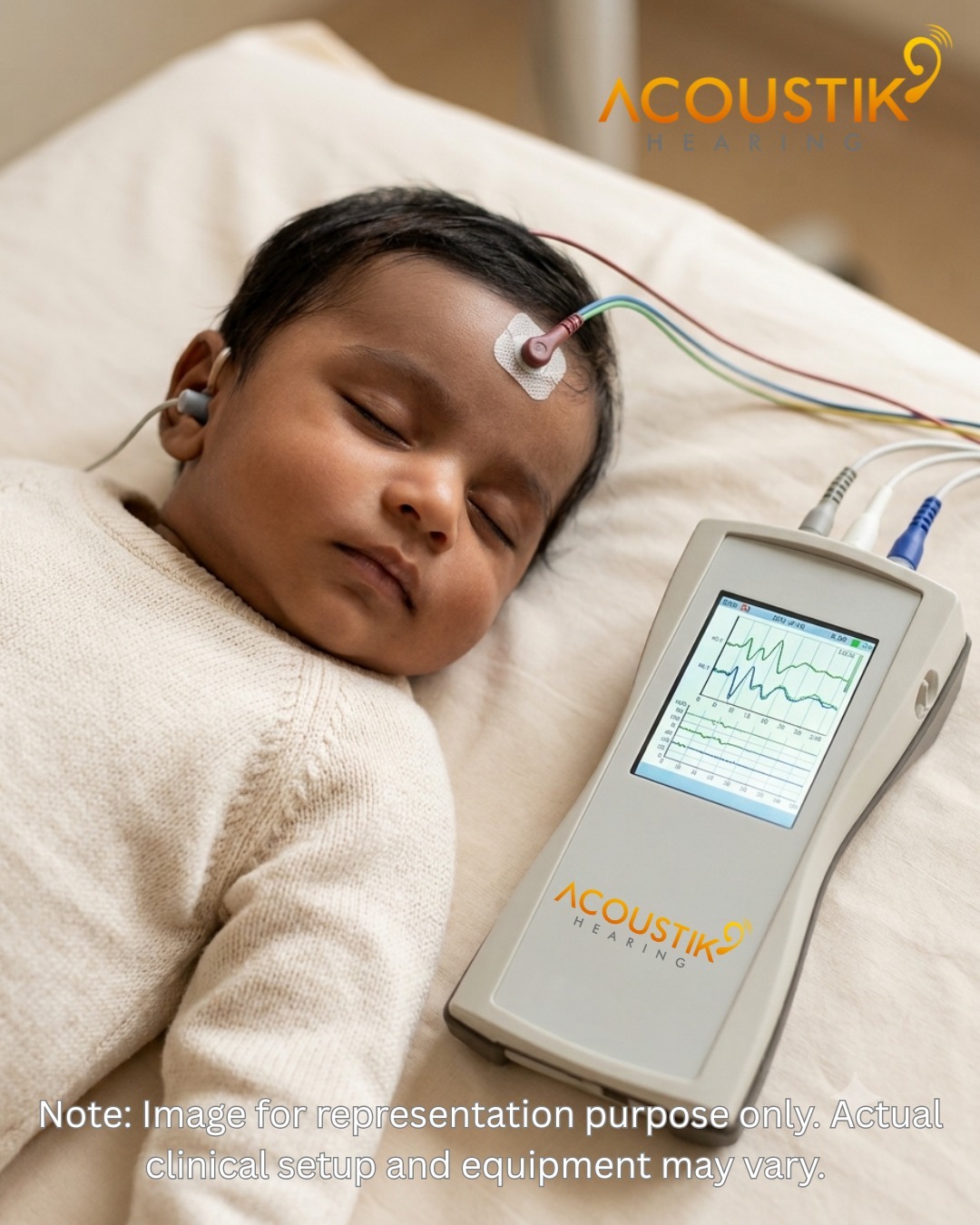
Before the test begins, the audiologist performs otoscopic
examination to ensure the ear canal is clear and may also perform tympanometry
or otoacoustic emissions if required. The skin is gently cleaned, and small
recording electrodes are placed on the forehead and behind each ear. Insert
earphones are then placed in the ears to deliver the test sounds. The patient
is asked to remain relaxed and still throughout the procedure. Babies are
usually tested during natural sleep after feeding, while some children may
require medically supervised sedation if they cannot sleep naturally. Adults
simply relax quietly with their eyes closed. The test generally takes 30 to
90 minutes, depending on the patient's age, cooperation, and degree of
hearing loss.
ASSR is completely safe, painless, and non-invasive.
The electrodes only record electrical activity produced naturally by the brain;
they do not deliver electricity into the body. Patients only hear a series of
soft clicking or humming sounds through earphones, making the procedure
comfortable even for newborn babies. There are no known harmful side effects,
and the test can be repeated whenever clinically necessary.
The results of ASSR provide an estimate of hearing thresholds for each ear separately. Normal responses usually indicate hearing levels within the normal range, while elevated thresholds suggest mild, moderate, moderately severe, severe, or profound hearing loss depending on the intensity required to obtain a response.
Audiologists interpret these findings
together with other hearing tests such as Otoacoustic Emissions (OAE),
Auditory Brainstem Response (ABR), Tympanometry, and behavioural audiometry
to obtain a complete understanding of the patient's hearing status. Although
ASSR is highly accurate, it does not replace a complete audiological
evaluation, and results should always be interpreted by a qualified
audiologist.
Compared with ABR, ASSR offers several advantages. It
provides frequency-specific threshold estimation, evaluates both ears
simultaneously in many systems, tests higher sound intensities, reduces
examiner bias through automated statistical analysis, and is especially useful
for severe and profound hearing loss. However, ASSR also has limitations.
Excessive patient movement, muscle activity, poor electrode contact, middle ear
disorders, and electrical interference can affect recording quality. In certain
conditions such as Auditory Neuropathy Spectrum Disorder (ANSD), ASSR findings
should always be interpreted alongside ABR and other diagnostic tests.
Early identification of hearing loss is essential because
hearing is the foundation of speech and language development. Children
diagnosed and treated within the first few months of life have significantly
better communication, educational, and social outcomes than those diagnosed
later. ASSR plays a crucial role in achieving early diagnosis by providing
reliable hearing threshold estimates even in patients who cannot communicate or
cooperate during traditional hearing tests.
At Acoustik Hearing & Speech Clinic, ASSR is
performed using advanced diagnostic equipment by experienced audiologists
following internationally accepted clinical protocols. Whether assessing a
newborn baby, a child with developmental challenges, or an adult requiring
objective hearing evaluation, ASSR provides valuable information that helps
guide hearing aid fitting, cochlear implant candidacy, rehabilitation planning,
and long-term hearing care. When combined with a comprehensive audiological
assessment, ASSR enables accurate diagnosis, early intervention, and
personalized treatment, helping individuals achieve better hearing, improved
communication, and an enhanced quality of life.
ASSR needs specialized electrophysiological equipment and a
quiet, shielded environment, so it's performed at our clinic. Acoustik
Hearing and Speech Clinic brings pure tone audiometry and hearing aid trials
to your home across @Mumbai, @Navi Mumbai, and @Thane — no travel, no waiting
rooms.
Book your pure tone audiometry and hearing aid trial at
home, or schedule your ASSR test at our clinic.
#ASSR #AuditorySteadyStateResponse #HearingTest #Audiology
#HearingHealth #HearingCare #InfantHearing #NewbornScreening #SpeechDevelopment
#HearingLoss #Audiologist #ENT #PediatricAudiology #ObjectiveAudiometry
#HearingAid #CochlearImplant #EarlyIntervention #SpeechTherapy #AcoustikHearing
#HealthyHearing
Follow us for more info on #HearingCare
https://www.facebook.com/acoustikhearingandspeech
https://www.instagram.com/acoustikhearingandspeech
https://twitter.com/Acoustikhearing
https://in.linkedin.com/company/acoustikhearing
https://www.youtube.com/@AcoustikHearing
https://www.acoustikhearing.com
https://www.hearingaidinmumbai.in
People also searched for
Hearing | Hearing Aid | Hearing Aid Dealer | Hearing Aid Dealers | Hearing Aid Clinic | Hearing Services | Hearing Aid Service | Hearing Aid Repair | Audiologist | Audiogram | Hearing Clinic | Digital hearing Aid | Bluetooth Hearing Aid | Waterproof Hearing Aid | Invisible Hearing Aid | CIC Hearing Aid | BTE Hearing Aid | ITC Hearing Aid | Rechargeable Hearing Aid | IIC Hearing Aid | Phonak | Unitron | Widex | Starkey | Resound | Oticon | Phonak Hearing Aid in Mumbai | Unitron Hearing Aid in Mumbai | Widex Hearing Aid in Mumbai | Starkey Hearing Aid in Mumbai | Resound Hearing Aid in Mumbai | Oticon Hearing Aid in Mumbai | Phonak Hearing Aid | Unitron Hearing Aid | Widex Hearing Aid | Starkey Hearing Aid | Resound Hearing Aid | Oticon Hearing Aid | Best Hearing Aid in Mumbai | Best Price Hearing Aid In Mumbai | Signia | Signia Hearing Aid | Signia Hearing Aid in Mumbai | Hearing Machine | Kanachi Machine | Latest Hearing Instrument | Advanced Hearing Aid | Latest Hearing Aid | Kan ki machine | Affordable hearing aids in Mumbai | Hearing Aid On EMI | Hearing Aid On installment | Hearing aid on 0% EMI | Hearing Aid Price in Mumbai | Free Home Hearing Test | Free Home Hearing Trial | Siemens Hearing Aid Price In Mumbai | Hearing aid clinic in Mumbai | Hearing Aid Center near me | Free Hearing Aid in Mumbai | Hearing Aid Near me | Hearing Aid for Senior Citizen